
Twelve Hours in a Bellville February
February is the hottest and driest month Bellville gets — typical afternoon highs near 27 °C and barely 20 mm of rain across the whole month.4 This is one of those days, walked from first light to last, wall by wall, with what we would actually fit and why. Every number below has a source at the foot of the page.
Prefer to read this on paper, or keep it? Download the whole guide as a PDF (1.1 MB).
A Bellville house has no single sun problem — it has six, in order
Most shading advice treats a house as one object with one answer. A February day here does not work like that. The room that is unbearable at half past six in the morning is comfortable by nine; the room that is perfect all morning is the one nobody can sit in after four. The order matters, because it tells you where the money should go and — just as usefully — where it should not.
Bellville sits in the Tygerberg hills roughly 25 km from central Cape Town, on the road out toward Stellenbosch and the Winelands.1 That inland position is the whole reason this guide reads differently from one written for the coast: no sea breeze arrives early enough to take the edge off the afternoon, and February brings the year's heat and its lowest rainfall together.4
Three sun angles do most of the explaining, and you can check the arithmetic yourself. Bellville sits at roughly 33.9° south. At midsummer the noon sun stands about 79.5° above the horizon; at the equinox about 56°; at midwinter about 32.7°.3 Everything that follows is those three numbers meeting a wall.
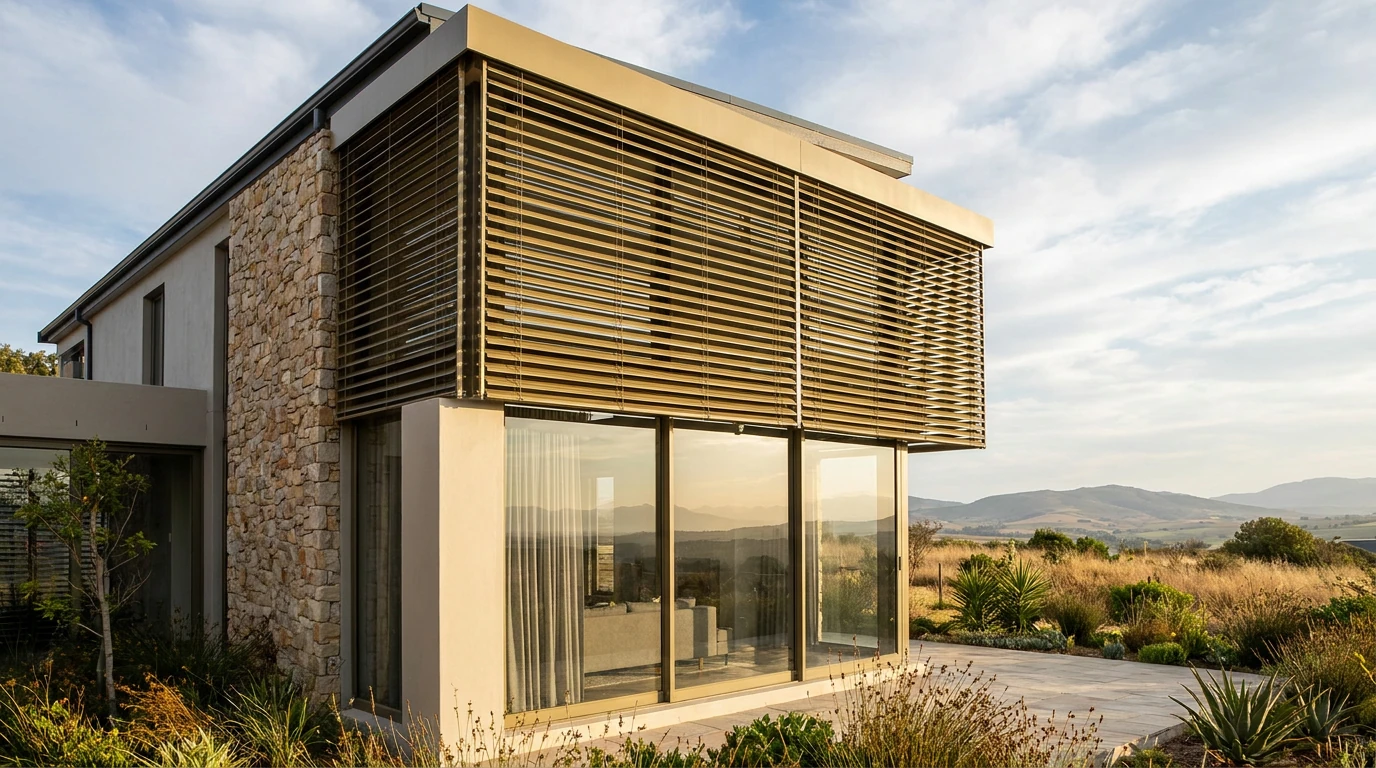
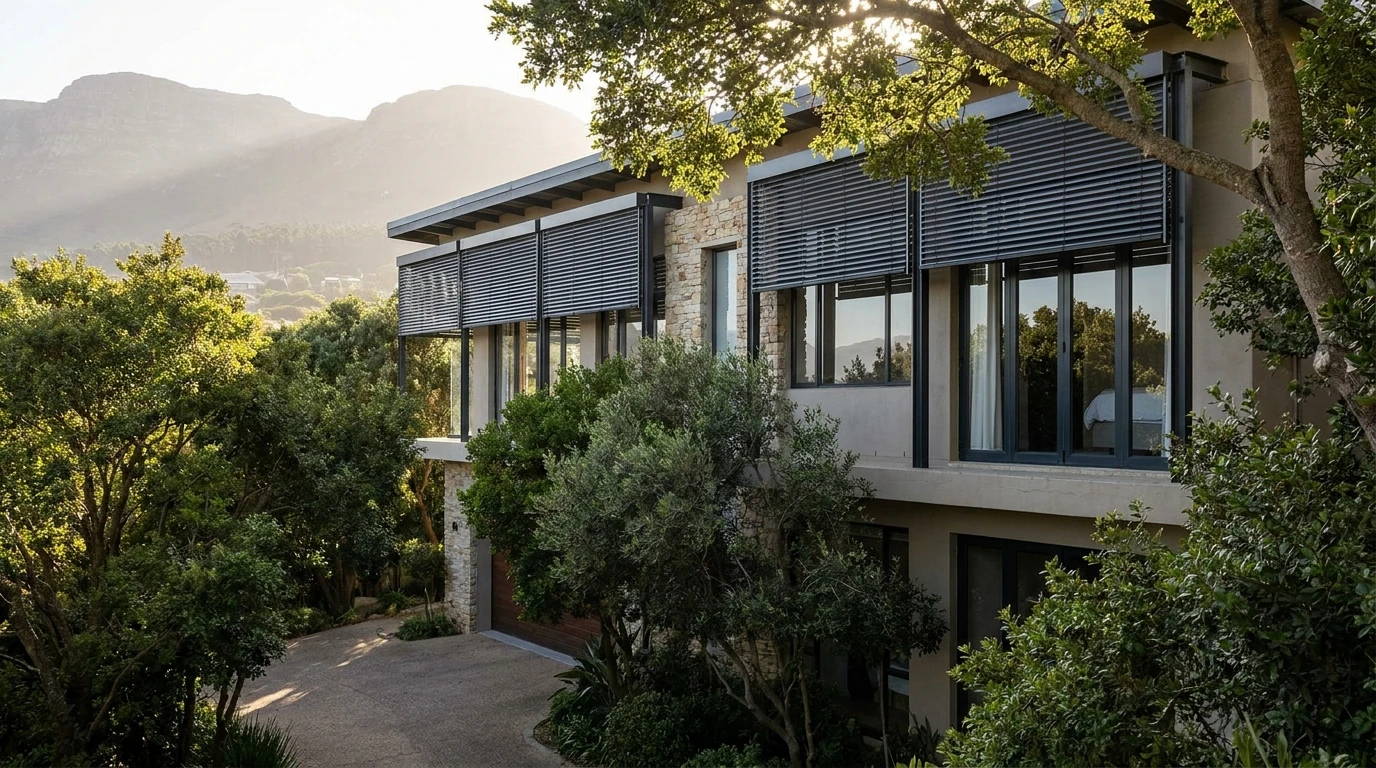
The same February day, read as four walls instead of one house. Shading built from the calculated sun angles in source 3.
The east rooms go first, and they are the cheap ones
In February the sun comes up south of due east and climbs quickly. East-facing glass takes it head-on, but it arrives against overnight-cool brick, cool tiles and a cool room — so what you have is a glare problem, not a heat one. A breakfast table you cannot look across. A bedroom that is bright at six and pointless to lie in by half past.
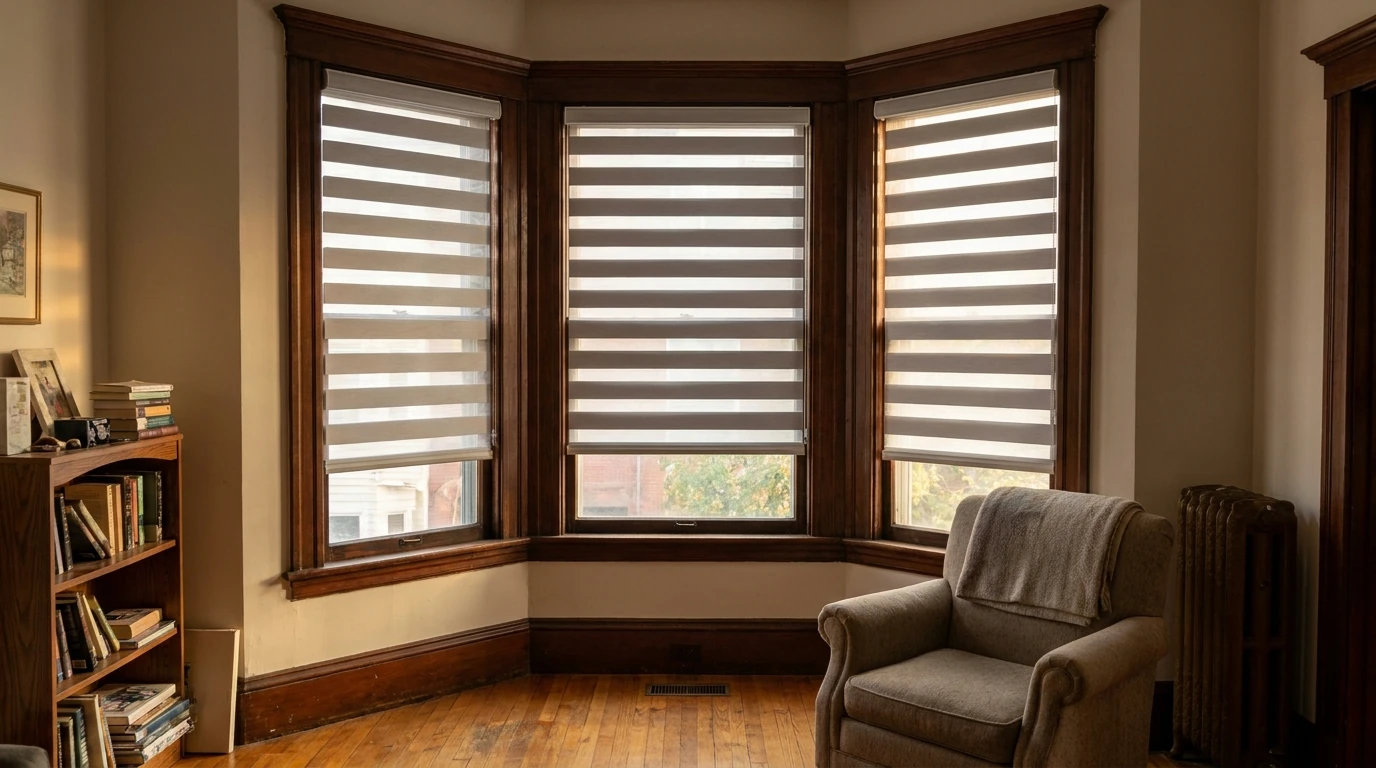
That distinction is worth money, because glare is cheap to fix and heat is not. An inside-fitted blockout roller sorts an east bedroom outright. A day-and-night banded blind suits the room that also has to work as a study by nine, because you can slide the bands and keep the view instead of choosing between dark and dazzled. Neither of those needs to be an exterior product, and we will say so.
Mid-morning to twoThe roof does the work, and most people never notice
By mid-morning the sun is high enough on the north side that the building starts shading itself. Here is the arithmetic, and it is worth doing once: the shadow an overhang drops down the wall below it is roughly the overhang's depth multiplied by the tangent of the sun's altitude. At the midsummer noon figure of 79.5°, a modest 600 mm eave throws a shadow about 3.2 metres down the wall — past the head of almost any north window in Bellville.3
So noon on the hottest day of the year is, on the north elevation, the easiest hour you get. This is why we push back when someone asks for heavy blockout on a north living room: you would be paying to switch off the one elevation that behaves itself, and you would feel the loss in June rather than now. North glass wants something adjustable — a sunscreen mesh, or aluminium slats you can tilt — not an off switch.
What is happening quietly during these hours is storage. Sun that came through glass in the morning has gone into floors, plaster and furniture, and it comes back out as the afternoon goes on. That is why a room can feel worse at four than it did at noon with no obvious change outside. Summer ultraviolet through this stretch runs in the very high to extreme band, commonly index 11 to 14 from October to March5 — the level that fades a carpet edge and a sofa arm over a couple of summers.
The west wall, and the only hours that genuinely cost money
Everything easy about noon reverses in the late afternoon. The sun drops toward the horizon and its light arrives almost horizontally, from underneath every eave you own. Run the same shadow arithmetic at a 20° altitude and that 600 mm eave shades barely 220 mm of wall.3 Architecturally, the roof has stopped helping. And in February those hours are long, hot and dry.4
Here is the part most people are never told plainly. An interior blind on a hard west window does not stop the heat — it intercepts it after the sun has already passed through the glass. The pane warms, the fabric warms, and both then radiate into the room. It helps with glare, and it helps a little with heat. On a big west pane it is not the answer.
The answer on a Bellville west elevation is something outside the glass. We lead with three, in this order:
External venetian blinds
Wide aluminium blades on the outside of the window, tilted or raised through the day. They stop the sun before it reaches the pane and still let you steer daylight and keep the view — the most controllable of the three, and the one we specify most often on a west living room.
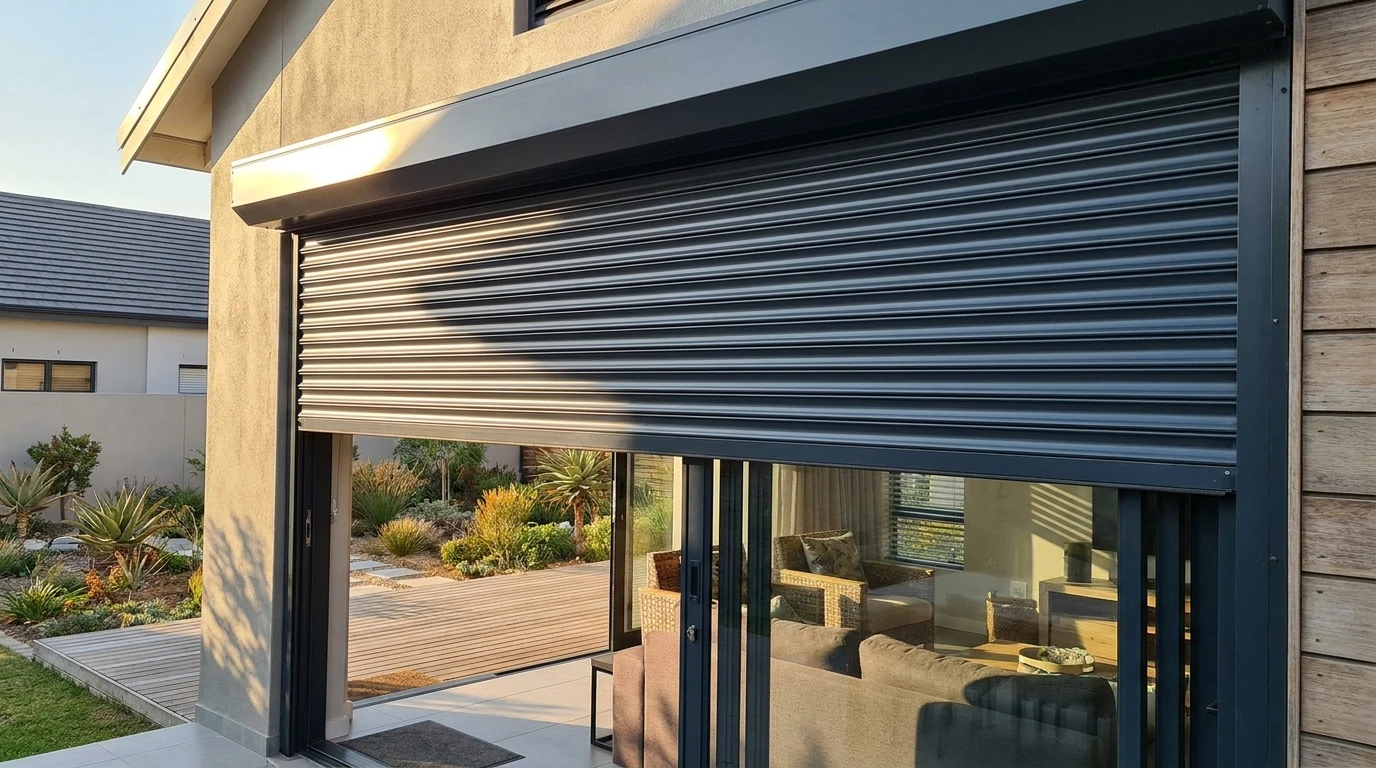
Roller shutters
Rigid aluminium slats that roll down outside the window from their own headbox. The strongest heat and blackout answer we fit, and the quietest against wind. Honestly labelled: what they control is sun, heat, glare and darkness. They carry no security rating, and we would rather say that here than let anyone assume it — that is a separate product on a separate quote.
Zip screens
Mesh tensioned inside side channels, so it holds its shape in wind instead of flapping. The right answer where the problem is a west-facing patio or braai room rather than a window — it closes the space in without boxing it up.
And the honest fallback
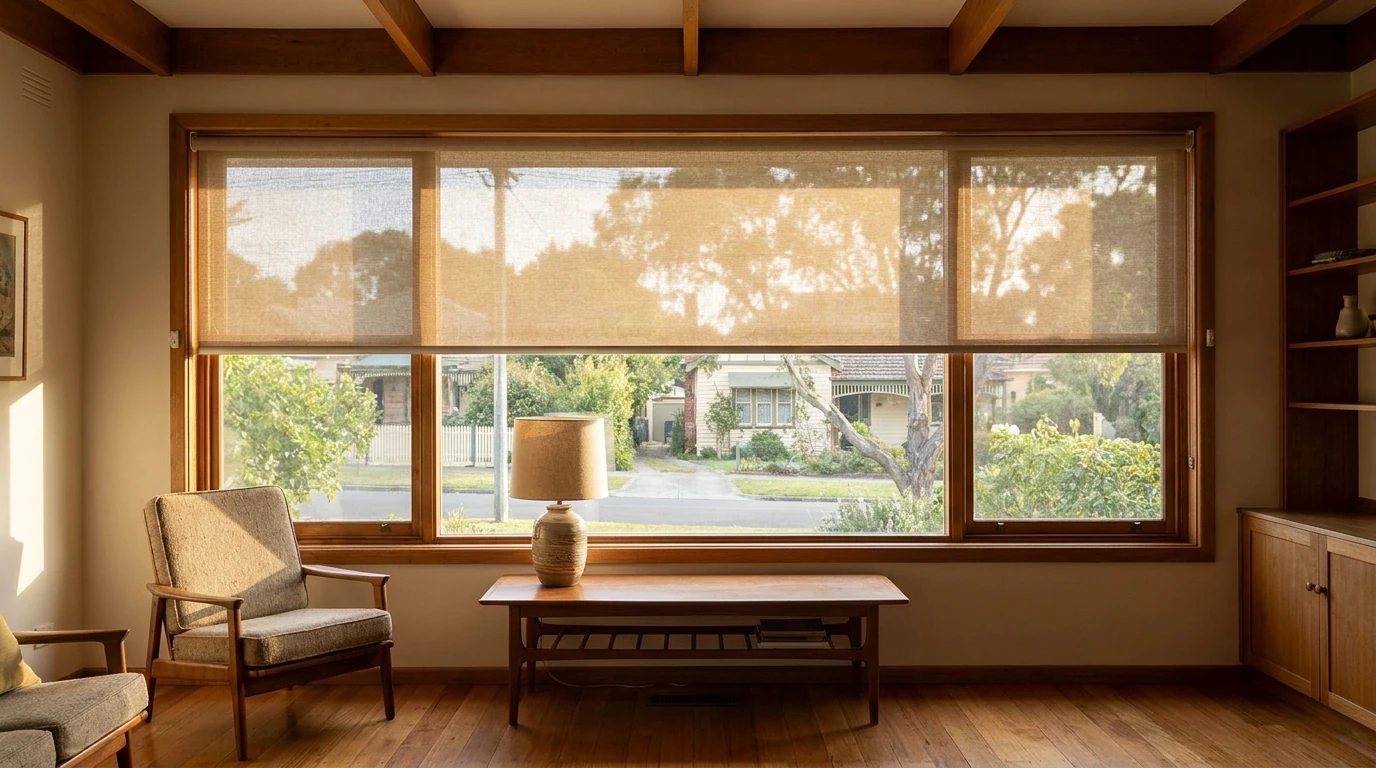
Where an exterior fixing is not viable — a rented home, a sectional-title facade, a budget that has to land elsewhere — a low-openness sunscreen roller, or a double roller with blockout behind mesh, is the best interior answer. Less heat control, meaningfully less cost. We will not pretend the two are equivalent.
All three exterior products get motorised with a wind sensor as standard on an exposed stand, which is the next section's problem.
The mesh reverses, and the bedroom argument starts
One limit worth stating before you buy: sunscreen mesh gives daytime privacy only. Once your lamps are on and the outside is dark, the effect flips and the lit room becomes the visible one. If a street-facing room needs privacy after dark as well, the honest answer is two layers — mesh in front, blockout behind, usually on a single double bracket — not a heavier mesh.
Bedrooms are their own conversation, and it is almost never about the fabric. Every blockout fabric is opaque; what wakes people is light leaking around the edges. Sit the blind inside the reveal and it looks the tidiest, with a thin bright line down either edge. Mount it across the whole opening instead and the room goes properly dark, but the reveal disappears behind it. Add channels down the sides of an inside fit and you get the darkness and the neat line together, for the price of one extra part. In Boston's original bay windows the reveals are shallow and occasionally out of square, which makes that choice a measurement question rather than a taste one.6
The south-easter does not wait for an hour to be convenient
The south-easter Capetonians call the Cape Doctor is the dominant summer wind, blowing roughly October to March and gusting to around 60 km/h on its strongest days.7 It matters for one reason: everything we just recommended for the west wall lives on the outside of the building.
Exposure is not uniform across Bellville, and this is where a site visit earns its place. Boston and Oakdale's older, denser street grid breaks the wind at ground level in a way an open stand simply does not; the higher, more open pockets of Loevenstein feel it noticeably harder. On an exposed stand a motorised awning or exterior blind gets a wind sensor fitted as standard — it retracts itself before the gust arrives rather than depending on someone being home to notice. On a sheltered courtyard behind a wall we will tell you that you can spend the money elsewhere.
And then JuneThe same window, the opposite complaint
Four months later the argument inverts. The midwinter noon sun stands at about 32.7°3 — low enough that the same 600 mm eave now shades only the top 390 mm of the wall, and sunlight reaches metres into a north room. That is welcome warmth, and it is the strongest reason not to over-specify north glass in February.
June is also Bellville's wettest month, at roughly 141 mm.4 The complaint changes from heat to cold and damp — a shaded south room that never gets direct sun, a bathroom with no airflow. Two practical consequences: cellular honeycomb blinds earn their keep in the cold-running rooms, because the trapped air in the cells insulates in a way a flat fabric cannot; and in bathrooms, kitchens and laundries we default to sealed aluminium slats rather than timber. Bellville is inland, so the coastal salt-corrosion story does not apply here — winter condensation is the hardware enemy instead.
Four addressesThe same February, four different houses
The hours above are Bellville-wide. What changes is the building they land on.
- Boston was established in 1900 on land known as The Willows, and still carries genuine Victorian-era stock — bay windows, wooden floors, pressed-steel ceilings.6 Shallow, sometimes out-of-square reveals; measured individually; timber slats sit well against that joinery.
- Oakdale is among Bellville's oldest suburbs too, classic-era and settled, with conventional openings that take a roller or a venetian without fitting compromises.
- Loevenstein overlooks the Boland Hills8 — which means the brief is never just "stop the sun", it is "stop the sun and keep that". Sunscreen mesh over opaque fabric on the view glass; the heavy work handed to an exterior product outside the pane instead.
- De Tijger sits at the foot of the Tygerberg Hills on the Parow boundary, tree-lined and green.9 Mature canopy gives real shade at ground level for much of the day — but upper-storey and gable glass sits above the trees and carries the full load, which is why the ground floor and the first floor of the same house often need different products.
The ridge those last two lean on has been named for a long time: the Tygerberg was recorded as Luipaerts Berghen, Leopard's Mountain, as early as 1657, for the leopard-spot pattern of the small hillocks on its slopes, and it rises to roughly 415 m.2 Bellville is built on those slopes, which is the honest reason "which street" changes an answer here more than it would on flat ground.
Five things a plan cannot tell you
- Which way each room actually points. Streets in Bellville run at every heading, and plenty of houses were turned to suit the stand rather than the road. Everything above depends on getting this right, and a phone compass takes ten seconds per room.
- Reveal depth, measured in more than one place. It decides inside-fit versus face-fit, which decides how dark a bedroom actually gets.
- What is behind the plaster. Solid brick, cavity or a later stud wall — what the wall is built of settles which bracket goes in, and whether its outside face can carry a system at all.
- Real wind exposure at your stand. Not the suburb's reputation. A walled Boston courtyard and an open Loevenstein terrace are different jobs.
- Where the power is. A motor within reach of a supply, or a battery tube you can drop and recharge without fetching a ladder, is what makes a high or wide opening practical rather than theoretical.
That is the whole honest case for a free measure: every one of those five is cheap to settle with a tape in your hallway and expensive to settle once a blind is already on the wall.
Have this read for your own house
The guide above is general to Bellville. A free in-home measure makes it specific: someone stands in each room with a compass, a tape and a case of fabric, answers the five unknowns above, and hands over a quote written out opening by opening. No charge, and no obligation either way.
No price before the visit
Every price follows the visit. We do not guess a number over the phone and then revise it on site.
Tell us the room, not the product
"The west lounge is unusable from four" is more useful to us than a product name. The specification is our job.
Sources
Nothing above is asserted without a source, and here they are. The sun-angle figures are worked out from Bellville's latitude with standard solar geometry and anchored on published Cape Town sun data rather than lifted from one page — the method is written into the text so you can repeat it. Where we could not verify something, it is not on this page.
- South African History Online — Bellville, suburb of Cape Town: the wagon halt at Hardekraaltjie and the Twelfth Mile Stone, proclamation as a town in 1861, the naming after Surveyor-General Charles Davidson Bell, and Bellville's position in the Tygerberg hills about 25 km from central Cape Town.
- Wikipedia — Tygerberg: the range recorded as Luipaerts Berghen in 1657 after the leopard-spot pattern of its hillocks, its height of roughly 415 m, and Bellville's position on its slopes.
- Sun angles worked out for latitude ≈33.9° S. The height of the sun at solar noon is 90° minus the difference between the latitude and the sun's declination, which swings ±23.44° across the year — giving ≈79.5° in midsummer, ≈56° at the equinoxes and ≈32.7° in midwinter. The eave-shadow figures are simply the overhang depth multiplied by the tangent of that altitude. Checked against the Cape Town sun tables at timeanddate.com.
- Climate-Data.org — Bellville climate, with monthly detail from weather-and-climate.com: Mediterranean climate; February the hottest and driest month, typical afternoon highs near 27 °C and roughly 20 mm of rain; June the wettest at roughly 141 mm.
- Nomadseason — Cape Town UV index: index commonly 11–14 from October to March, the "very high" to "extreme" band. Aggregator source, cited as such.
- Wikipedia — Boston, Bellville: established in 1900 on land known as The Willows, with Victorian-era housing stock including bay windows, wooden floors and pressed-steel ceilings.
- Cape Town Magazine on the Cape Doctor and the Wikipedia entry for the same wind: the south-easter dominates the summer months, roughly October to March, and gusts to around 60 km/h on its strongest days.
- Seeff — Loevenstein area profile: an established Bellville suburb overlooking the Boland Hills.
- Seeff — De Tijger area profile: a tree-lined suburb of large detached homes at the foot of the Tygerberg Hills on the Parow/Bellville boundary.
What we recommend above is our own judgement, given free and with nothing attached to it. It is not an approval opinion: if a complex, body corporate or estate controls what may be fixed to the outside of your home, that call is theirs, and we raise it at the measure rather than leaving you to discover it afterwards.
Still just reading?
That is fine — the guide is free and there is nothing to sign. When you are ready, the measure is free too.
Book your free measure